CURATORIAL PROJECTS

Forever Foreigner: The Films of Clara Law
20 - 28 September 2025 | ICA | Hong Kong Film Festival UK
First retrospective of Clara Law in the UK.
Clara Law is often introduced as part of the ‘Hong Kong New Wave,’ although she refuses to be defined by territorial labels, a form of categorisation she continually challenges throughout her body of works. Born in Macau, raised in Hong Kong, and now based in Melbourne, Law—like many of her characters—is perpetually in motion, crossing national borders and cultural boundaries, making the sense of displacement in diaspora a recurring theme in both her life and work.
This retrospective charts the turning points in her career, beginning with They Say the Moon Is Fuller Here, her rarely screened first feature, made while studying film in London after directing drama programs at the Radio Television Hong Kong. Returning to Hong Kong in the 1990s, Law emerged as a rising filmmaker with Farewell China, the first instalment of what became her ‘migration trilogy’. In 1994, she moved to Australia with her partner and long-term collaborator Eddie Fong, and gained recognition at major festivals with Australian-made films, including The Goddess of 1967. In her latest work Drifting Petals, she revisits Macau and Hong Kong, reflecting on her personal ties to both cities. Some of the films are shown for the first time in the UK.

The Cinema of Qiu Miao-jin
16 August 2025 | The Barbican Centre
A memorial screening honouring Qiu Miao-jin 邱妙津, a trailblazer in Taiwanese queer literature and author of Notes of a Crocodile, marking 30 years since her untimely death.
If you have come across Qiu Miao-jin’s writing, it wouldn’t be difficult to notice the pronounced presence of cinema in her works. Qiu is known for her distinctive diaristic, confessional style of writing, in which the introspection of characters is often mediated by film. There are extensive references to films and filmmakers in her books: Francesco Rosi’s Chronicle of a Death Foretold, Tsai Ming-liang’s Vive L’Amour, Wong Kar-wai’s Chungking Express, quotes from Andrei Tarkovsky, and many more. Some chapters are even dedicated to reflections on particular films.
In Last Words from Montmartre, Qiu’s narrator recounts the ecstasy she experienced watching Theodoros Angelopoulos’s The Travelling Players at the Centre Pompidou:
During the four long hours of the movie there were a number of tedious, awkward scenes that made it feel like political propaganda, but there were also some serenely tender and astonishingly beautiful scenes as well. I was wholly attentive for the first three hours before I started to yawn, but then, for some unknown reason, laughter burst from deep within my body—just suddenly burst out…. Life is so beautiful! (28)
Not only did Qiu profess her love for cinema through the cinephilia of her protagonists, her writings are often delivered in the form of screenplays, as in Notes of a Crocodile, where the protagonist uses Derek Jarman as her alias and describes scenes from his film The Garden:
The scene cut to the seaside. A bathtub was floating in shallow waters. Someone wearing a white mask was reclining inside, their body cloaked in a white robe. The bathtub was lined with holes into which bouquets were stuffed. (Note: That part of the video had been lifted from The Garden.) (241)
These words were written as if she were behind the camera, orchestrating every frame that unfolded on screen.
Bonnie Huie, the translator of the book, said she “immediately recognized the interdisciplinary nature of her writing, which assimilates the theory behind auteur cinema, where one’s style can essentially be expressed through formalism, including the sequential and rhythmic arrangement of images,” during her first read of the novel.
Qiu’s works are inherently cinematic. Yet few people know that she was also an aspiring filmmaker in real life.
In his memorial piece about Qiu, the cinematographer and co-writer of Ghost Carnival, Lin Hsu Wen-er, shared his experience collaborating with her and mentioned that she had plans to study film in Paris. Later, we learn that instead of film, she continued her studies in psychology and feminism, becoming a student of French philosopher and writer Hélène Cixous.
Made in 1991 and adapted from her eponymous short story, Ghost Carnival was recently digitised from its 16mm original negative by the Taiwan Film and Audiovisual Institute. After its international premiere at Haus der Kulturen der Welt in 2022, the film gained popularity on the European festival circuit, screening at least three times in London alone within a year. Nevertheless, few seem to note that she also wrote and directed another film, Guide Me to Sleep, a 23-minute short about a man struggling with insomnia. The exact production year remains unknown. The only available copy was on VHS, and unfortunately its quality was severely degraded—viewable only in low resolution with grinding background noise and flickering lines on screen.
This latter film has never been publicly screened and circulates solely through fragments included in Evans Chan’s documentary The Love and Death in Montmartre. Nonetheless, it is clear that filmmaking was a creative avenue Qiu was passionate about and eager to further explore. Thirty years since her passing, we gather to celebrate her artistic achievements across literature and moving image.
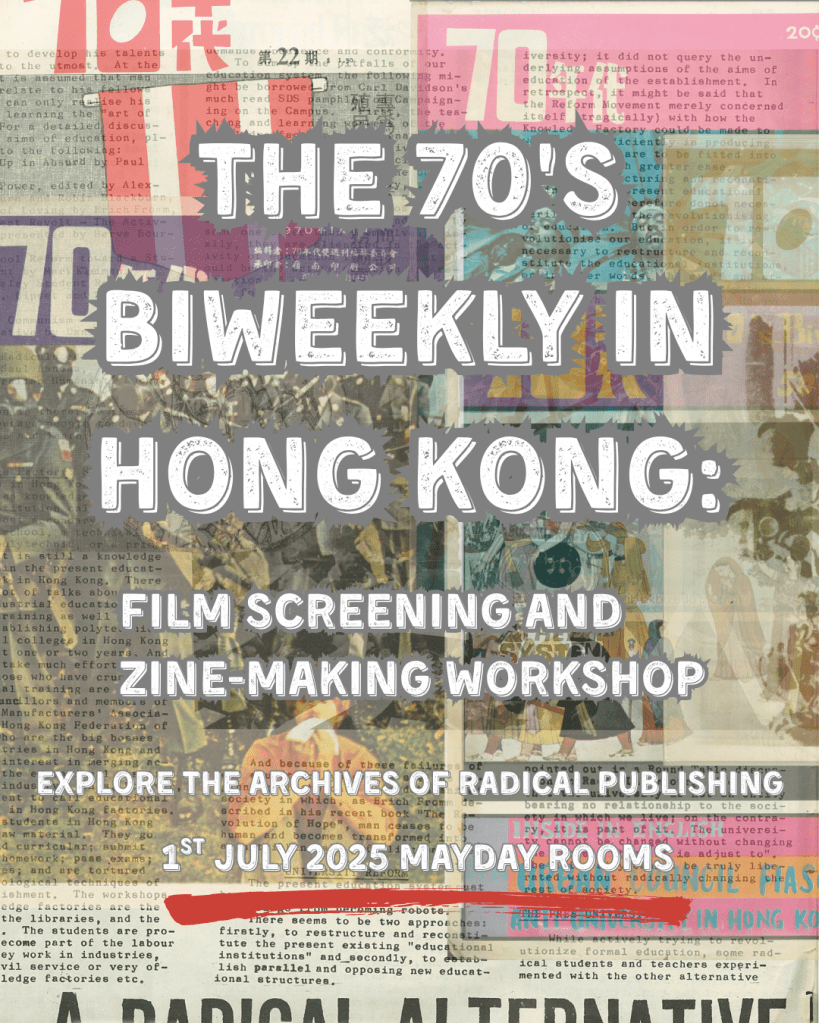
The 70’s Biweekly in Hong Kong: Screening & Zine-making
1 July 2025 | MayDay Rooms
An event that dives into the archives of the legendary 70’s Biweekly through films and zine-making to explore the possibilities of radical publishing.
The 70’s Biweekly is an independent youth magazine that advocates radical political theories, social activism, and avant-garde art in 1970s Hong Kong. The first part of the event was a screening of two films about the legacy of the magazine: Letter to the Young Intellectuals of Hong Kong 給香港的文藝青年 (1978), a film co–directed by Mok Chiu-yu, one of the founders of the 70s Biweekly, with Li Ching, and Voice of Book (책의 목소리) (2023), in which filmmaker Kwon Soo-yeon draws connections between Hong Kong’s activism and South Korea’s May 18 Gwangju Uprising, following the traces of independent publishing in social movements. The second part was a zine-making workshop that engages with the archives of the 70’s Biweekly and the MayDay Rooms, led by artist Kayla Lui.

The Woman, the Orphan, and the Tiger: Screening & Dictee Reading
25 September 2024 | Bertha DocHouse
A screening of The Woman, The Orphan, and The Tiger by Jane Jin Kaisen and Guston Sondin Kung a collective reading of Theresa Hak Kyung Cha’s magnum opus Dictee.
Following a group of transnational adoptees and other women of the Korean diaspora in their 20s and 30s, the film unveils how the return of the repressed confronts and destabilises narratives that have been constructed to silence histories of pain and violence inflicted onto the bodies and lives of women and children. The screening was followed by a collective reading of Theresa Hak Kyung Cha’s magnum opus Dictee, a genre-bending masterpiece that addresses the fragmentation of language, image and memory, and a discussion with Cici Peng from Sine Screen, Dot Zhihan Jia from the Feminist Duration Reading Group, and Natalia Christofoletti Barrenha from Cinema Mentiré about the book and the film.
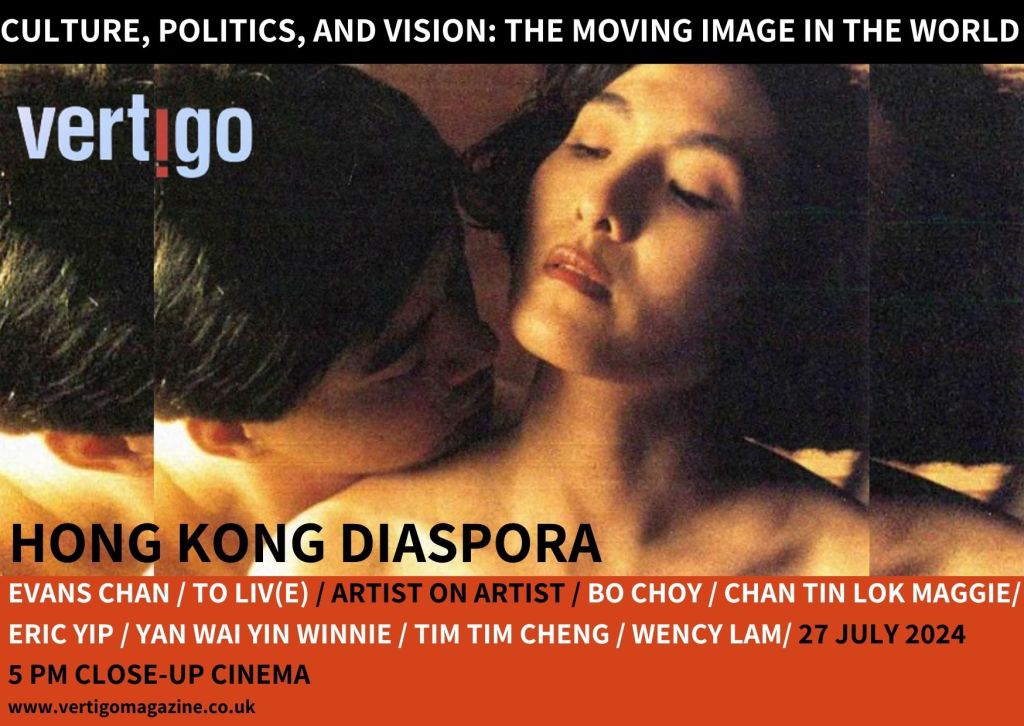
Hong Kong Diaspora: To Liv(e)
27 July 2024 | CLOSE-UP
“Today, when I’m asked where home is for me, I am struck by how far away it is; and yet, home is nowhere else but right here, at the edge of this body of mine.” – Trinh T. Minh-ha, Far Away, From Home, 2011
This programme celebrates Vertigo, UK’s leading independent film magazine between 1993-2012, that championed the culture of independent moving image. In the spirit of Vertigo, Lu presents a rare screening of To Liv(e), the debut feature of Hong Kong Independent filmmaker Evans Chan alongside events that aim to initiate a conversation around the Hong Kong diasporic experience and politics embedded in the film, especially in relation to the present time.
The screening is accompanied with commissioned creative responses by UK-based Hong Kong artists – Bo Choy, Eric Yip, Yan Wai Yin Winnie, Tim Tim Cheng and Wency Lam. Bo Choy, Wency Lam and Chan Tin Lok Maggie will attend a post-screening discussion.

Korean Film Nights 2024: Ma-eum 마음
21 June - 10 July 2024 | ICA | KCC UK
A selection of films that use documentary cinema as a tool to express unique voices, preserve memory against the tide of forgetting, and maintain identity in the face of colonialism and modernisation.
Film is a powerful form of expression; a voice that takes many forms but is at its most powerful when spoken from the heart. “Ma-eum” can mean both heart and mind, symbolising the inseparable bond between reason and emotion.
Theresa Hak Kyung Cha describes Ma-eum as a true spirit, an inherent part of a person’s soul that remains unshaken by displacement or oppression. It resides in memory and is present in every word we speak.
We have curated a selection of films that use documentary cinema as a tool to express unique voices, preserve memory against the tide of forgetting, and maintain identity in the face of colonialism and modernisation.
Our artists express themselves through imagery, speech, action, and song, whether collectively or individually, personally or publicly, intimately or boldly. They speak from the Ma-eum, the spirit-heart.
Many of our films are screening in the UK for the first time. Our programme includes shorts, artist films, features, and audiovisual works that explore historical events in both documentary and essayistic approaches. We aim to present a chorus of voices that demonstrate cinema’s unique ability to turn the specific into the universal. Experience the resonant power of Ma-eum; a symphony of spirits and memories.
Film is a powerful form of expression; a voice that takes many forms but is at its most powerful when spoken from the heart. “Ma-eum” can mean both heart and mind, symbolising the inseparable bond between reason and emotion.
 eleanor lu